The Floor Plan: Three Stations Within Six Steps
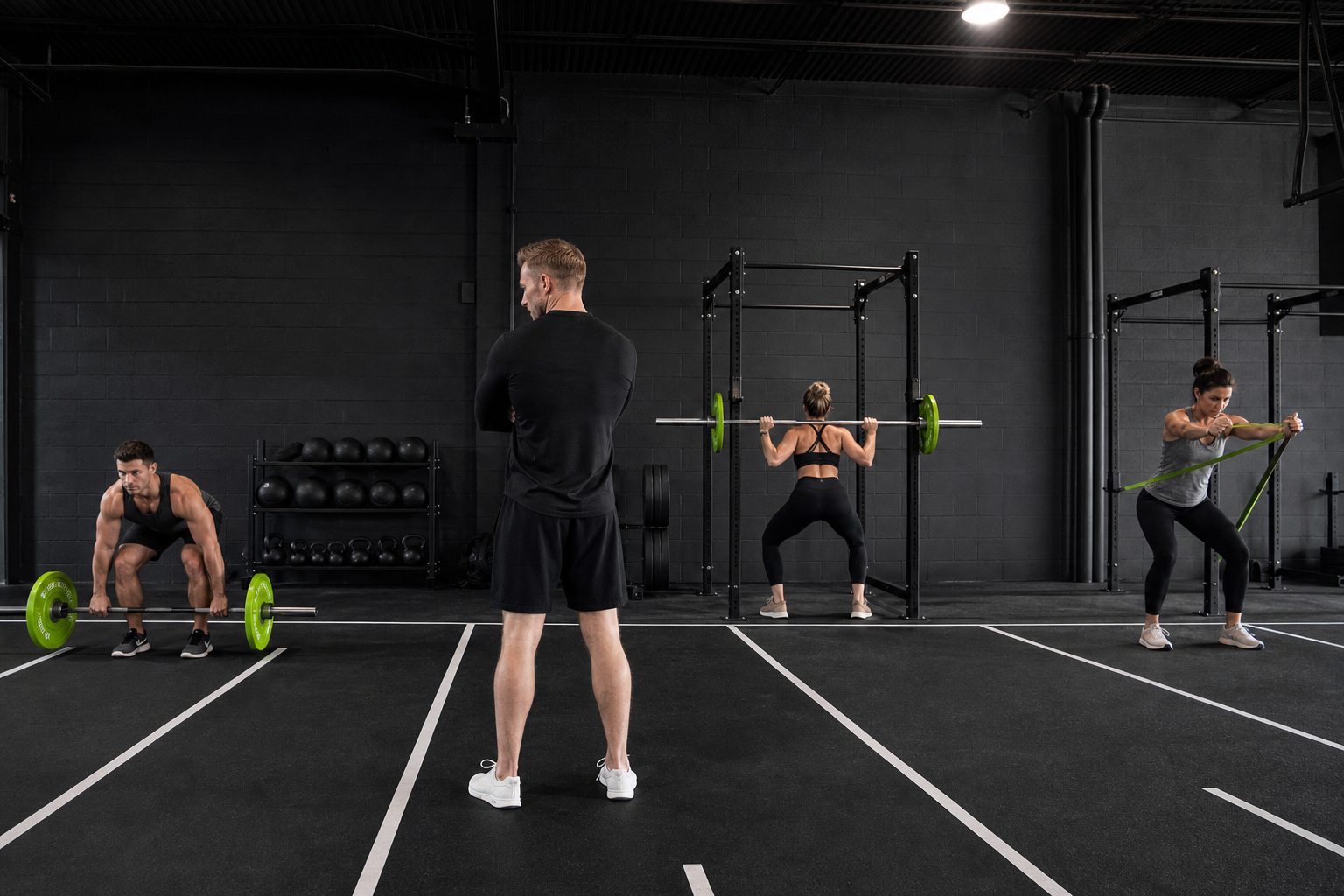
A semi private hour relies on a careful floor plan. Most coaches working with three clients at once set up three workout zones, each with enough space for movement and an eye on safety. The rule of thumb: nobody should need to walk more than six steps to reach the next exercise. This keeps the coach in the center, able to scan all stations in a glance.
Typical layouts use a triangle or a line along one wall if the room is narrow. One corner might hold a squat rack, the opposite side a bench and dumbbells, and a third spot kettlebells or a sled. Each area must allow clients to move without interfering with the next person. Tape on the floor or colored mats help clients find their place quickly between sets.
Coaches who work in small gyms or repurpose group fitness spaces often have to get creative. Portable equipment, like adjustable benches and mobile storage carts, make it easier to reset stations between sessions. When equipment is fixed, the one rack, the one cable column, rotations are planned so each client uses that anchor piece at a different time.
Keep reading: How to Build a Weekly Client Check In That Gets Answered
Staggered Starts and the First Ten Minutes
Semi private coaching sessions rarely start with all three clients launching into their main lifts at once. Instead, coaches stagger arrivals by five minutes or use a shared dynamic warm up to buy time for check ins. This buffer period is critical, especially when clients arrive at different fitness levels or have lingering injuries.
Some coaches set out foam rollers and mini bands for self-guided mobility work as clients trickle in. The first client might begin with goblet squats, the second with single-leg glute bridges, while the third is still pulling off their jacket. This gives the coach a few minutes for individual questions and to spot anything unusual, limps, hesitations, or missing gear, before the main block begins.
Time management in the opening minutes sets the tone for the hour. A digital timer or a simple wall clock helps, but most coaches keep a paper session sheet to jot down who is where and track the warm up sequence. The goal: nobody stands around, and nobody jumps into a loaded barbell cold.
Programming Three People Around One Piece of Equipment
When three clients share one key piece of equipment, scheduling the order is part of the workout design. Coaches often write programs with "A, B, C" blocks, so only one client uses the squat rack while the others are busy with goblet squats or banded rows on the floor. After a set, clients rotate clockwise.
Programs need built-in flexibility. If one client is rehabbing a knee, their "B" block might be all upper body, while another rotates through deadlifts. Coaches often prep a backup circuit or bodyweight exercise in case someone needs to skip a station. This makes sure traffic flows smoothly and nobody stands idle.
Managing Rest and Pacing
Rest periods are easier to control with a station-based setup. Coaches set expectations at the start: as soon as you finish your set, walk to the next station, sip water, and get ready. For clients who move fast, coaches extend the rep range or add a mobility drill as filler. Slower clients are gently nudged to keep the group together.
Paper or digital logs help everyone remember what comes next. Some coaches stick printed programs on clipboards at each station, while others use whiteboards or a large wall calendar. The goal is that nobody gets lost, especially when the coach is across the room with another client.
Keep reading: Gym Space for Independent Trainers: Four Cost Structures Compared
Coaching Cues When You Have Twelve Seconds Each
With three people in motion, attention is split. Coaches learn to scan all stations, make a quick correction, then move on. Each client gets a few seconds of direct feedback per set. This demands sharp observation and economical language.
Rotating Focus and Triage
Coaches often follow a pattern: watch Client A's deadlift setup, cue Client B's pushup form, spot Client C's lunge depth, then cycle back. The highest risk lift or least experienced client gets priority. If someone is working close to failure, the coach shadows their set, then hurries back to the next station.
Verbal cues become shorter. Instead of a full explanation, it's "chest up," "heels down," or "brace core." Coaches rely on visual demonstrations at the start, then reinforce with single-word reminders. For clients who need more attention, coaches might pair them with simpler moves or reduce the load to minimize risk.
This approach takes practice. New coaches often speak too long, missing signs at other stations. Veterans walk the floor in a loop, using eye contact and gestures to keep everyone on track. The best communicate confidence in few words and listen for signs of confusion or distress.
The Equipment Doubles That Make or Break the Hour
Running three clients at once only works with the right mix of equipment. Most coaches double up on the most used items: two sets of dumbbells in key weights, two adjustable benches, and extra resistance bands. If a client is left waiting for a single set of 20-pound dumbbells, the session can grind to a halt.
Some gyms offer enough space to keep all equipment on hand. In smaller studios, coaches pre-stage gear before the hour starts. This minimizes lost time during transitions and cuts down on walking back and forth. For popular items like kettlebells, coaches might program two similar weights so that at least two people can work at once.
When equipment is limited, coaches get creative. For example, if only one barbell is available, the other two clients can do single-leg deadlifts or TRX rows. Some coaches keep a backup list of bodyweight alternatives for every main lift, ready to swap in if something is in use or space is tight.
Dealing With Equipment Malfunctions
Missing pins, stripped threads, or broken bands can derail a session. Coaches inspect gear before clients arrive, but if something fails mid-session, the fastest fix is to pivot the client to a similar movement. The group model works best when everyone can stay active, even if the plan shifts on the fly.
See how CoachCheckIns handles this for fitness and personal training
Spotting Risk and Where Your Attention Actually Goes
Managing three clients at once means risk monitoring is nonstop. Coaches have to watch for breakdowns in form, signs of fatigue, and anything that could cause injury. The main focus is always on the heaviest lifts and the least experienced person.
In practice, attention tends to flow to whoever is moving the most weight or seems least confident. Coaches stand close during deadlifts, squats, or presses, then move back for less risky exercises like planks or band walks. When possible, they position themselves to have all three clients in view.
Communication and Nonverbal Cues
Coaches rely on nonverbal signals: a raised hand, a pause, or even a nervous glance. Those small cues often show when a client feels unsure or is about to make a mistake. Quick check-ins, "You good?", and eye contact help keep communication smooth without breaking the session flow.
When a client struggles, the coach adjusts the program or offers a regression on the spot. More experienced clients may get less direct feedback but are checked in on regularly to prevent complacency or lapses in technique.
Coaches also keep an eye on group dynamics. If one client is struggling, others may notice and start to help or lose focus. Managing morale and pacing is as important as spotting form errors.
Pricing, Attendance, and the One Client Who No Shows
The semi private model shifts the math of the personal training hour. Instead of charging full price for one client, coaches set a lower per-person rate, knowing they can serve three or four people at once. This can double or triple hourly revenue, even after accounting for increased prep and equipment costs.
Most coaches require clients to pre-book or commit to a consistent schedule. This helps avoid gaps and makes it easier to plan sessions. When one client no-shows, the coach still runs the hour for the remaining two. Some coaches offer make up sessions, but many do not, to keep the schedule predictable.
No shows do create a challenge. With only two clients, there's more downtime per person. Coaches often fill the gap with extra form checks, technique drills, or a longer cool down. Over time, experienced coaches build a waitlist or allow flexible drop-ins to keep sessions full.
Tracking Attendance and Communication
Regular attendance matters more in the group model. Coaches keep attendance logs and follow up quickly when someone misses a session. Text reminders or automated emails help nudge clients to show up or reschedule in advance. The more consistent the group, the smoother the sessions run and the better the results.
Payment policies are usually stricter in semi private training. Most coaches require payment up front for a block of sessions, which discourages cancellations and last minute changes.
Who the Model Suits and Who Should Stay One to One
The semi private approach works best for clients with some experience in the gym who are comfortable working semi-independently. These clients benefit from attention and correction, but do not need every rep supervised. They enjoy the camaraderie of a small group and like having a set schedule.
It is not a good fit for true beginners who need hands-on coaching for every movement or those with complex injuries that require constant modification. Clients who struggle with motivation or prefer total privacy may also prefer one to one sessions. Coaches need to assess each client's readiness before moving them into a group.
Coaches themselves also need a certain temperament. The model suits people who can multitask, communicate clearly, and adapt programs on the fly. It rewards preparation and quick thinking. For those who prefer deep focus on a single client, it can feel hectic and unsatisfying.
The semi private model demands solid systems for programming, tracking, and communication. Automated weekly check ins, adherence scoring, and at risk flags help coaches stay ahead of small problems before they become big ones, without losing track of each client's needs as their roster grows.